
Closing Arguments: Conversations in the Cosmere RPG

Max Brooke, Consulting Designer
The Cosmere Roleplaying Game provides rules for three key scene types: Combats, Endeavors, and Conversations. While developing the Mistborn Handbook, the team took the opportunity to update rules for conversations to better clarify how to apply conversation mechanics while taking a narrative-first approach. Here’s a design diary all about conversations from Max Brooke, Consulting Designer for the Cosmere RPG and Plotweaver system!
From the outset of designing the Cosmere RPG, the design team knew that we wanted it to have a solid mechanical structure for debates, discussions, negotiations, and intrigue. The stories of the Cosmere pivot not just on climatic battles and acts of martial heroism, but also on expressions of ideas and beliefs between people. Whether these are connections forged through mutual understanding or schisms caused by differing moral frameworks, we knew that it was important that we give GMs and players the tools to play out dramatic moments of communication like the ones we see in the Stormlight Archive, Mistborn, and the rest of the Cosmere.
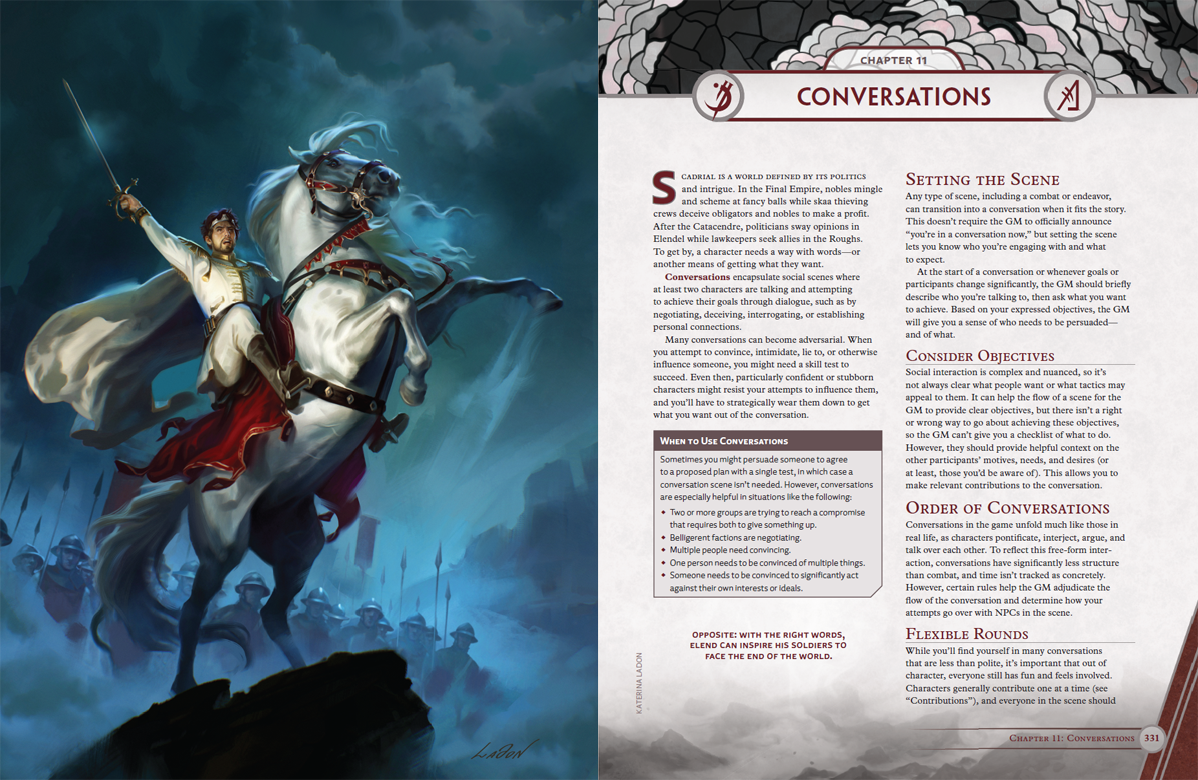
A conversation scene can be used to handle a heated debate, an interrogation, or even an inspiring speech.
We also knew from experience as designers that this framework needed to be lightweight and not overly restrictive. Structuring conversations with the same level of mechanical detail as combat can often feel intimidating or cumbersome, and we knew we wanted a system that was rigorous, but also aligned with the natural flow of roleplaying many groups already follow in such scenes.
In the stories of Scadrial, from the last days of the Final Empire to the tales of the Roughs, we see a great deal of focus on building coalitions among disparate factions, aligning diverse ideologies against mutual enemies, and tense infiltrations of dangerous hierarchies. As such, the design team felt this was the right time to expand on the GM guidance around conversations. While the rules have not changed from what you’ll find in the Stormlight Handbook, the following section has been added to help GMs in their adjudication of conversation scenes.
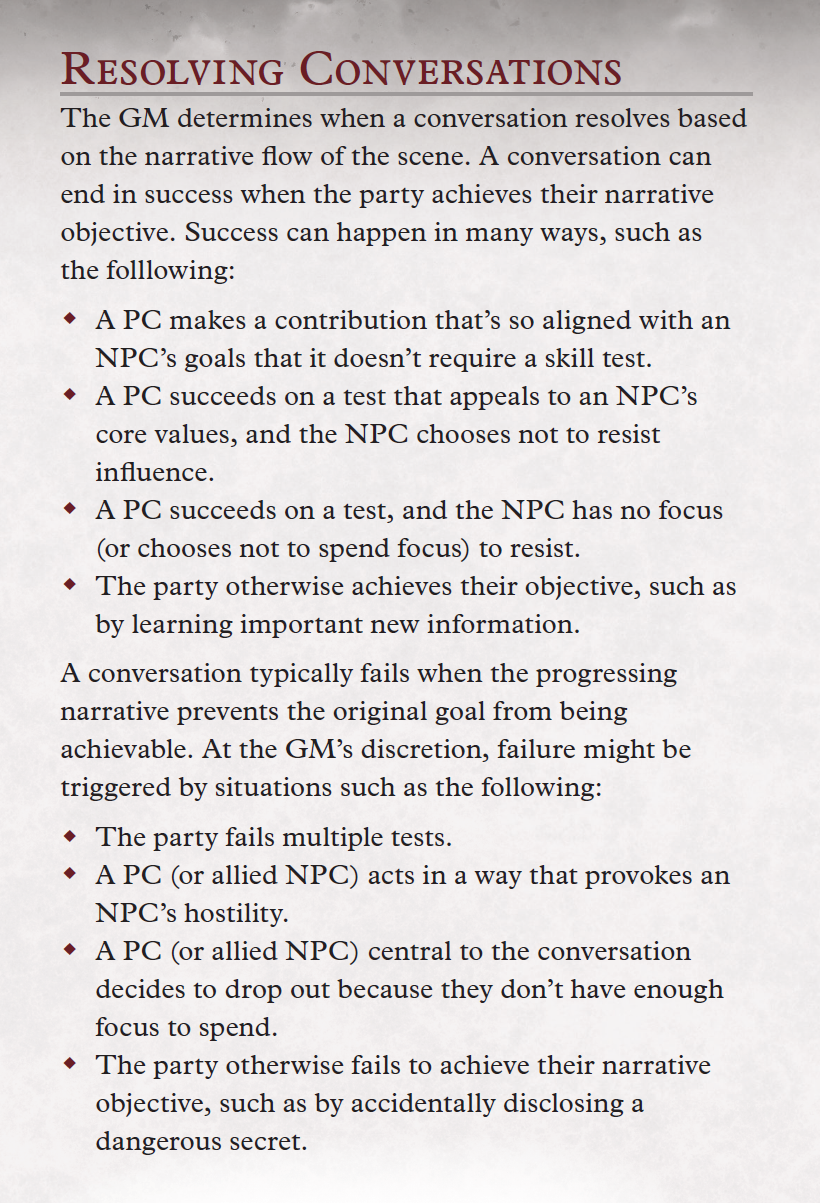
To see this section in context, download an excerpt from the Conversations chapter.
It can be tricky to know when to end a conversation, and this new section expands on some ways that a conversation may draw to a close. Focus provides a metric of each character’s ability to continue the conversation, and taking advantage of this is sometimes crucial to success. But often, PCs will succeed (or fail) well before anyone has been worn down this way. As we said at the outset, the conversation rules are meant to help give structure to the flow of roleplaying most groups find natural, not to impose specific mechanical criteria on all social interactions. Generally speaking, this means watching as the conversation progresses, and asking “Has the PC’s objective already been achieved, and if not, is it still possible?”
For instance, the PCs might succeed by coaxing a key NPC into alignment with their objectives, or even just revealing that NPC’s goals and their own converge. They might even achieve their objective in a way that doesn’t put them into direct conflict with anyone else. Once the objective is resolved, the conversation can generally wrap up unless there’s a pressing narrative reason for it to continue.
Alternately, just because the PCs have focus left to resist the influence of others does not automatically mean their objective is still tenable. If the PCs bring forth their best arguments unsuccessfully once, simply repeating those same arguments might bore or even provoke NPCs who would be open to novel approaches. And sometimes, newly revealed information might change or expose the demeanor of NPCs such that the PCs could not reasonably succeed in their original objective. In these cases, the GM should use their best judgment and the guidance above to help the conversation draw to a natural close.
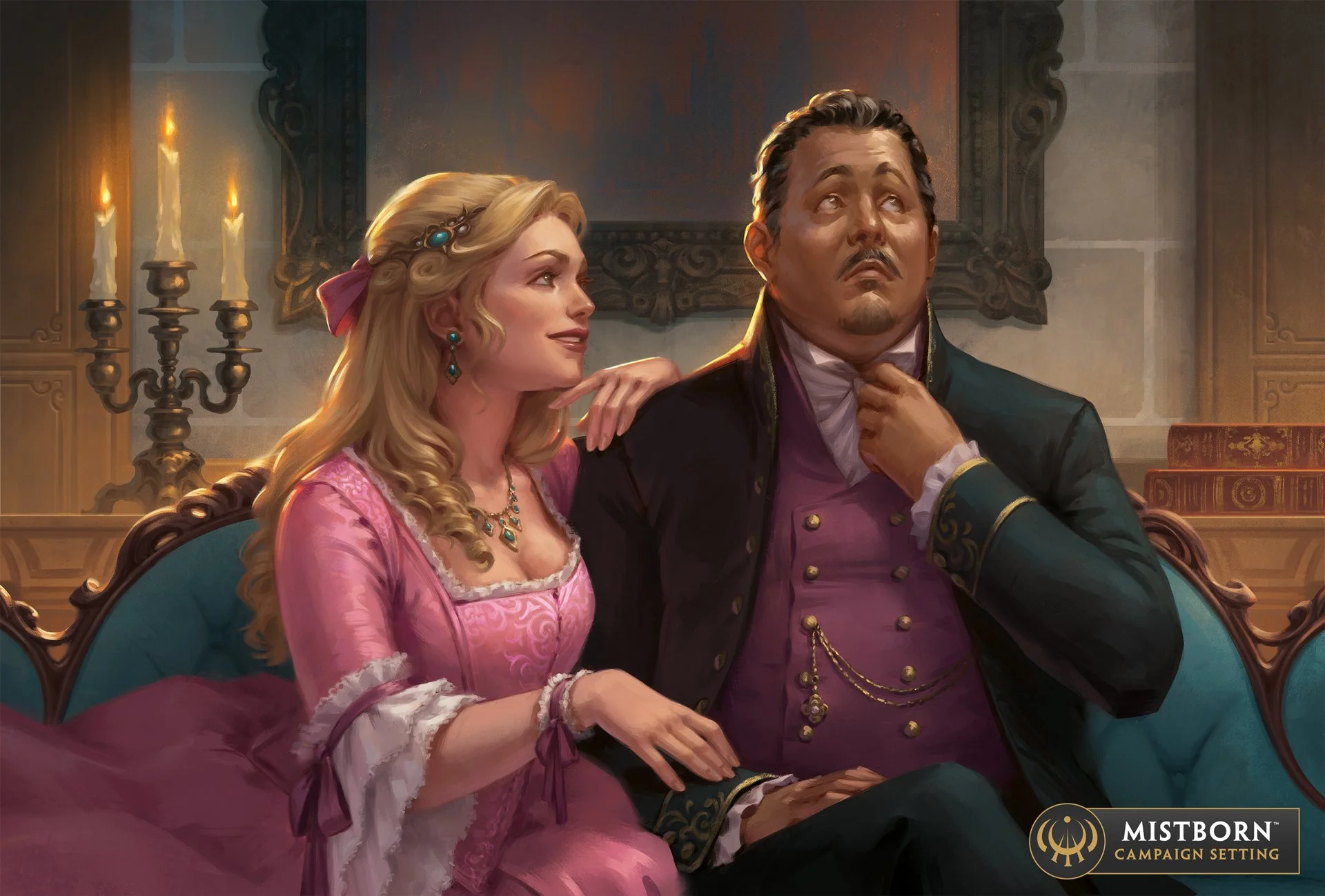
Allrianne & Breeze by Deandra Scicluna
In Mistborn, conversations gain an added dimension thanks to Allomantic Brass and Zinc. Characters with these powers can open new avenues of conversation through Soothing and Rioting. While this type of emotional manipulation does not function as mind control, it can allow characters to bypass certain tests (like not needing to intimidate a guard with Rioted fear) or make tests they couldn’t ordinarily attempt (like Soothing an official’s suspicions to create an opening for deception).
We’ll share more about emotional Allomancy as we approach the Fall launch of the Mistborn Handbook. In the meantime, we hope that GMs and players of all Cosmere RPG games find this expanded guidance useful as they spin alliances and intrigue across the Cosmere!